
Finding Champaign County Residents
Choose the first record from what is already known. An exact street address points to the county tax lookup and CCGISC maps. A full name tied to a lawsuit belongs in the Circuit Clerk search. A person from an earlier decade is better traced through city directories, newspapers, probate, and cemetery material. The county covers Champaign, Urbana, Rantoul, Mahomet, Savoy, St. Joseph, smaller villages, townships, and rural land. A municipal record may exist beside a county record, so first identify the legal municipality as well as the mailing city.
Official sources have narrow jobs. Parcel data usually identifies an owner, not every occupant. Voter lookup confirms registration only when the required personal facts match. A deed index names parties to a recorded instrument, while a directory captures one publisher's dated canvass. These limits make a research log vital.
- Normalize the street address and save the municipality, USPS place, ZIP, PIN, and retrieval date.
- Check the Treasurer and Assessment routes for parcel facts, then view CCGISC map context.
- Use the PIN in Recorded Deed History and inspect the full instrument when needed.
- For a name question, select the court, voter, vital, archive, or directory source that fits the purpose.
- Record what was searched, what was absent, and which custodian can supply an older or nonpublic item.
The Champaign County services page is a useful starting point for countywide routing.
See the county's service overview before choosing an office.
The county overview helps separate county services from city, state, and private record systems.
Champaign County Directory Offices
The Clerk and Recorder keeps vital certifications, election records, deeds, mortgages, liens, plats, surveys, and related recordings. The Chief County Assessment Office handles values, exemptions, notices, cadastral mapping links, and property record-card questions for more than 76,000 parcels. The Circuit Clerk keeps court files, while CCGISC supplies address, parcel, aerial, tax-atlas, and jurisdiction context. These offices do not maintain the same resident list. Call ahead because Clerk and Recorder services appear at both the administrative center and the Washington Street service location.
Champaign County Clerk and Recorder
102 E Main Street
Urbana, IL 61801
217-384-3720
Illinois State Board of Elections
Online registration confirmation
Illinois statewide service
County Clerk: 217-384-3720
Route Champaign County Records
The county's department directory gives the office-by-office route. Court files go to the Circuit Clerk, not to county FOIA. Restricted birth, death, marriage, adoption, voter, and law-enforcement information does not become open merely because someone files a broad request. Administrative records that are not already searchable may be requested from the department that created them.
Review the official department list and contact details.
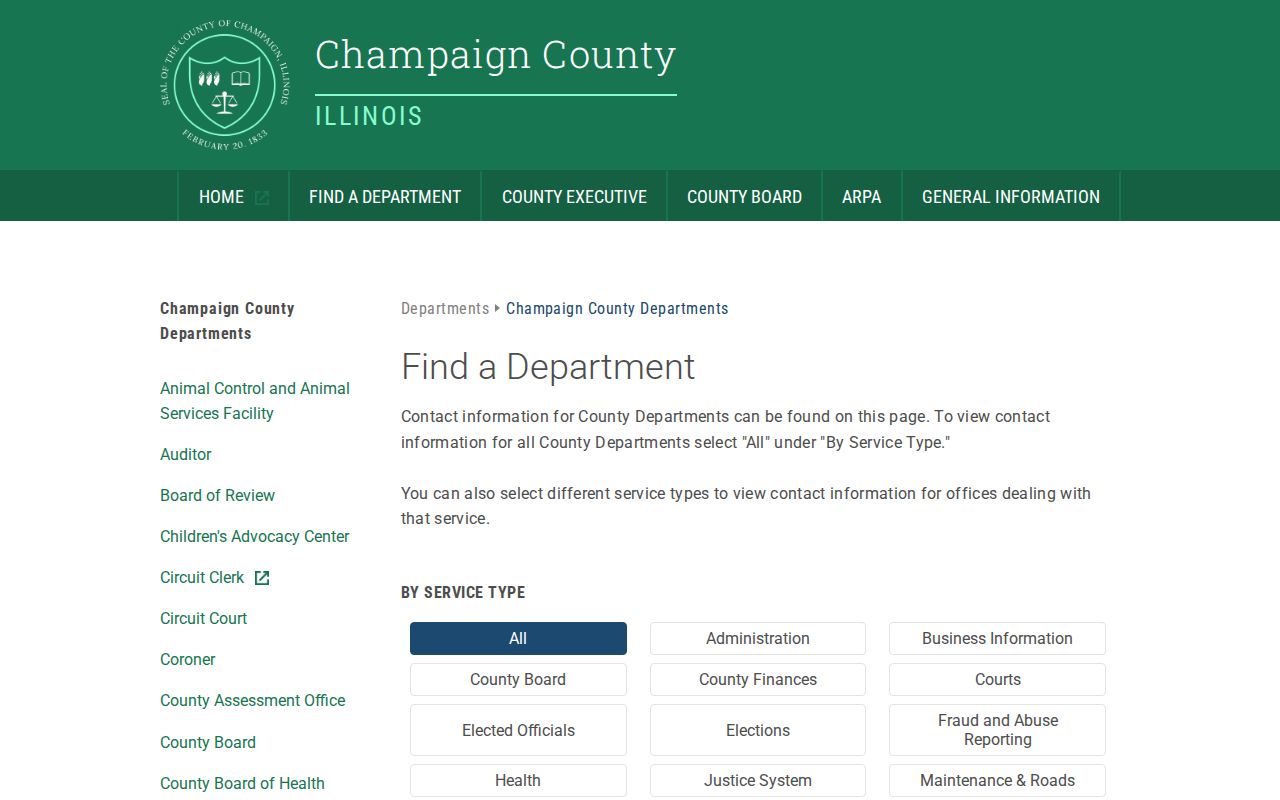
This list is the cleanest way to avoid sending a request to an office that does not hold the record.
Champaign County Parcel Clues
Property research works best from the PIN, the parcel identification number. Search the County Treasurer by PIN or by house number and street. The location form omits punctuation and directions on city streets, uses short suffixes such as St or Rd, and formats a rural road as a road number plus direction. The Assessment Office can answer questions about assessments, exemptions, notices, cadastral mapping, and property record cards. CCGISC then adds parcel geometry, aerials, school and census layers, zoning, and jurisdiction.
- Parcel
- A mapped unit of land identified by a PIN.
- Index
- A finding tool that points to a record but may not contain its full text.
- Roll
- A dated official list, such as an assessment or registration roll.
- Criss-cross directory
- A directory arranged by address or phone rather than only by surname.
Open the Assessment Office's property information route.
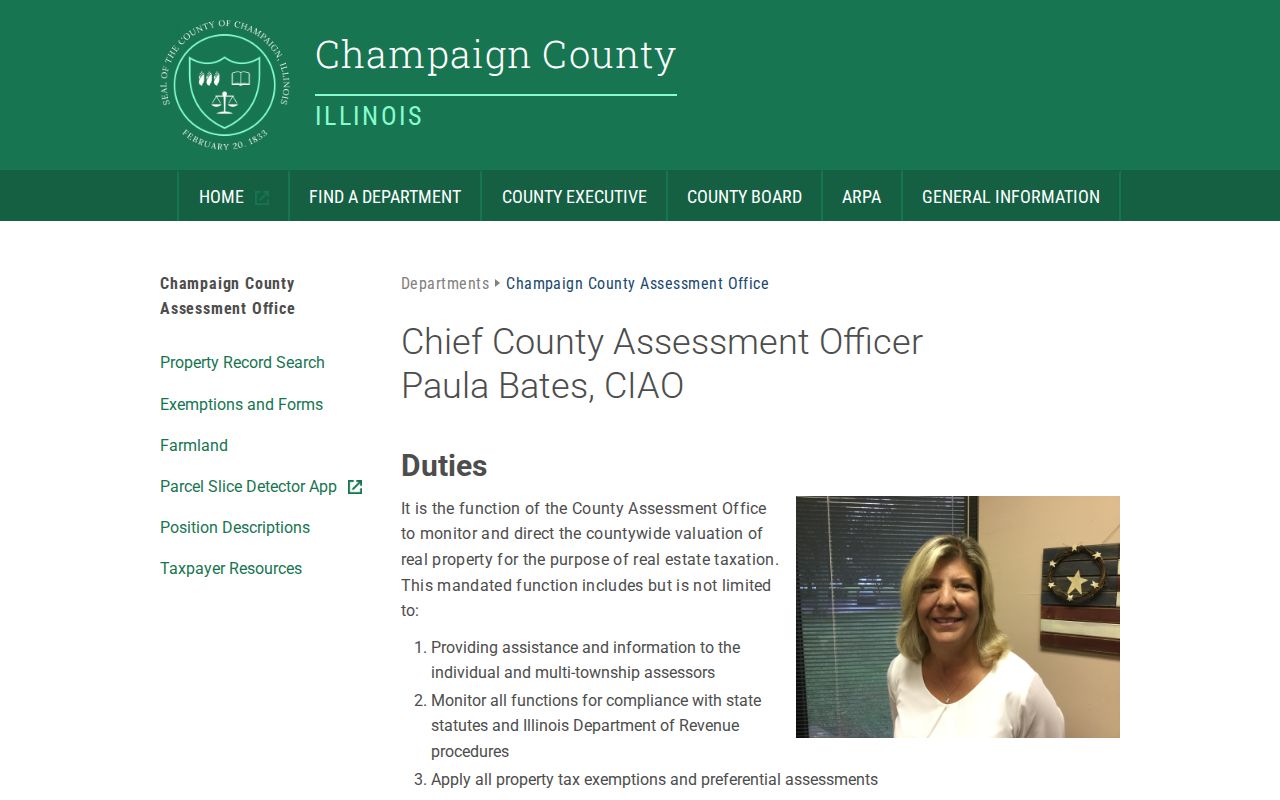
The assessment route identifies the custodian when a portal result needs a source date or record-card follow-up.
Current Champaign County Directories
Today's directory-like sources are separate official indexes. Their coverage depends on the event behind each record. A parcel roll covers owners, a court index covers parties in filed cases, and the voter tool confirms an individual registration when the required inputs match. None is a full list of Champaign County residents. Compare the record date and the role shown before treating two similar names as the same person.
| Source | Who It Lists | Keeper | Access |
|---|---|---|---|
| Tax and assessment roll | Parcel owners and property facts | Treasurer and Assessment Office | Online, phone, or counter |
| Registration confirmation | A voter whose required details match | State Board of Elections | Limited online lookup |
| Recorded deed history | Selected parties to deeds | Recorder and CCGISC | Free lead, paid image |
| Public case information | Parties in eligible court cases | Circuit Clerk | Online, viewing room, request |
| Organization registry | Public group contacts and boundaries | City or association | Public contacts, not member rolls |
Start with the narrowest suitable roll. For example, an estate matter may justify probate research, while a property question belongs in the parcel and deed chain. A reconnecting search can often use a library, alumni group, or other neutral contact without locating a private home.
Search Champaign County Deeds
The CCGISC Recorded Deed History search accepts a PIN and lets the user select result order and direction. It is intentionally incomplete. The county warns that the page shows deeds only and may display just one grantor and one grantee when an instrument has more parties. A result can lead to the external Tapestry service, where an account or credit card may be needed to view the image. The public result is a lead, not a complete chain of title.
| Field or control | How to use it |
|---|---|
| Search PIN | Enter the parcel identifier tied to the normalized address. |
| Order Results By | Choose the available field that best fits the review. |
| Order Direction | Read newest-first for current work or oldest-first for a backward chain. |
| Result link | Preserve the document lead before entering the paid image service. |
Review CCGISC's public mapping role before relying on map output.
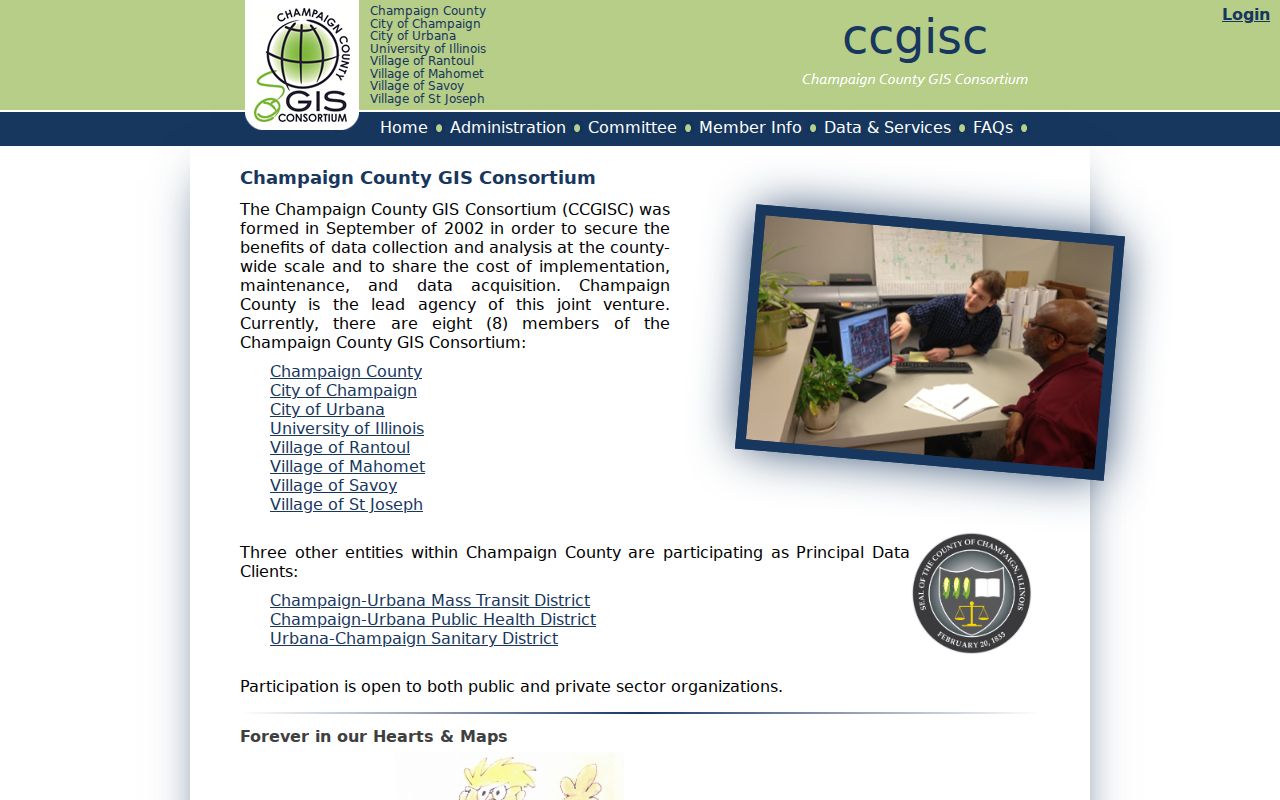
CCGISC connects local governments and parcel data, but its maps remain general indexes rather than legal surveys.
Paid Champaign County Images
The full recorded image can show facts absent from the short deed-history result, including all parties, the legal description, document type, consideration when stated, book and page or file number, preparer, return address, and recording details. The county sends image users to Fidlar's Tapestry. Current Champaign County image coverage, field choices, and price were not available in the research crawl, so verify those terms on the live service before paying.
Check the Tapestry login and payment landing page.
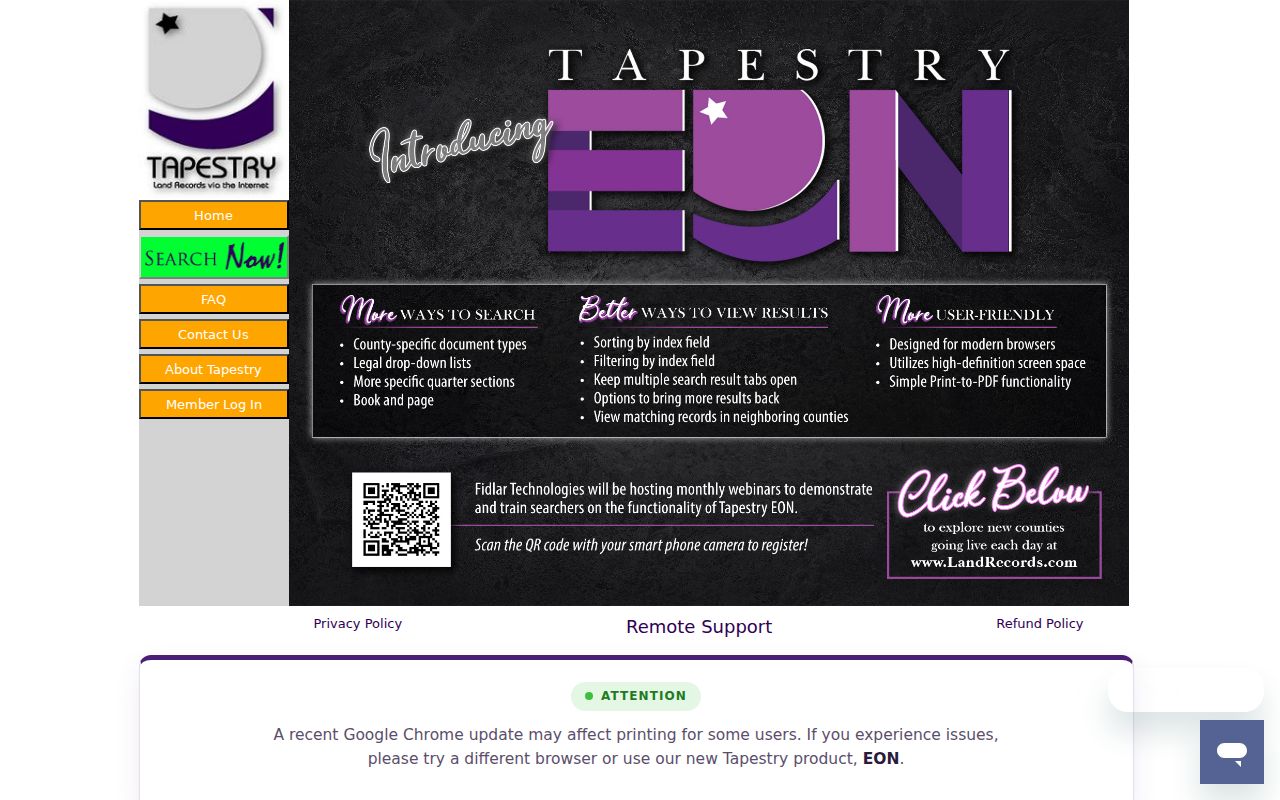
The paid service is most useful after the free PIN search has produced a specific document lead.
For a certified copy or help with an older instrument, contact the Recorder. A title abstract, plat, assessment card, or probate file may also explain a break in the chain. Never infer occupancy from a deed alone.
Champaign County Court Names
The Circuit Clerk's public case information can answer whether a name appears as a party in an eligible local case. Online civil coverage is stated for cases created on or after January 1, 2010. Older cases, file images, certification, and some copy needs route to the courthouse viewing room or the clerk's written record-search form. That form asks for names, birth date, years, record category, desired document, copy or certification choice, and return contact details.
Read the Circuit Clerk's court-file access guidance.
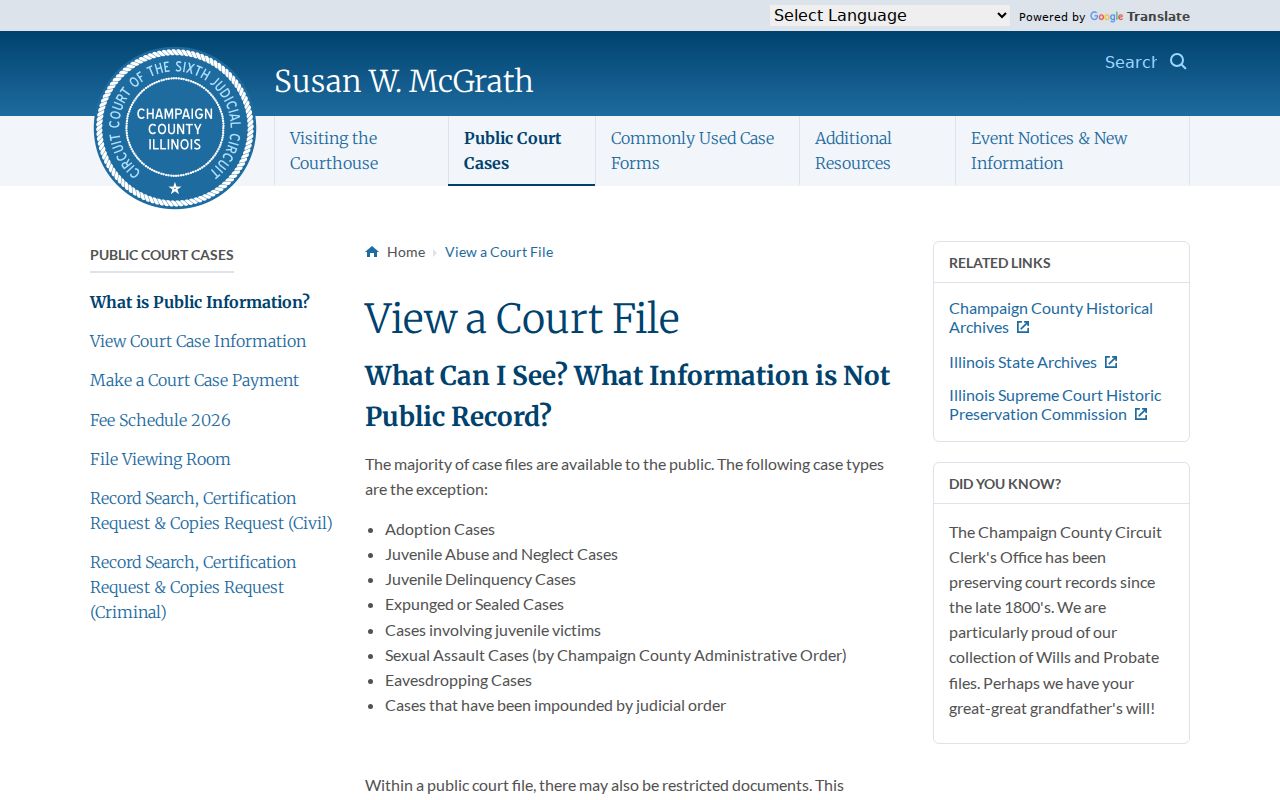
The guidance distinguishes online case information from the underlying file and explains why some categories remain sealed or excluded.
A case result establishes a filing, not a current residence. Match at least two identifiers and inspect the disposition, meaning the recorded outcome, before drawing a conclusion.
Request Champaign County Records
Illinois Freedom of Information Act requests work for nonexempt county administrative records that are not already searchable. Send the request to the department FOIA officer by mail, fax, email, or hand delivery. Describe the record series, address, date range, and format. Noncommercial requests generally receive a response within five business days, with an allowed extension of up to five more. The first 50 black-and-white printed pages are free; later pages are 15 cents each, and color pages after 50 are 30 cents each.
Use Champaign County's official FOIA instructions.
The county instructions show the correct request route and help distinguish inspection from copies or electronic delivery.
FOIA does not replace the Circuit Clerk's court process or the eligibility rules for vital certificates. Privacy exemptions in 5 ILCS 140/7 may also require redaction.
Verify Champaign County Voters
Illinois offers an individual voter registration lookup, not an open statewide people directory. The official form requires first name, last name, birth date, and ZIP, with street controls used in some paths. State computerized voter data is governed by the Election Code and has privacy and use restrictions. Telephone numbers, Social Security numbers, street numbers, birth dates, email addresses, and other sensitive data may be withheld or limited.
Use the lookup only to confirm the registration at issue. Do not scrape it, build a household list, or treat a match as proof of present occupancy. The county's bulk-file request details and fee were not found in the research, so the County Clerk is the proper source for current terms.
Note: A voter result confirms registration information under Illinois rules, not every adult at an address or the person's present location.
Champaign County Vital Limits
Birth, death, and marriage records require a different path from a public directory. The County Clerk and Recorder handles local certifications. CUPHD maintains county birth certificates for the past ten years and limits copies to the named person, a parent on the record, or a legal guardian with proof. IDPH birth records begin in 1916 and are not public. Certified death access requires the relationship or property-right basis specified by the custodian.
Genealogy has its own products and date thresholds. The Urbana Free Library and CCHA describe a county death index for 1878 through 1949, registers from 1878 through 1901, certificate holdings for parts of 1902 through 1945, and later local material. IRAD lists additional county series. Call first to learn whether the item is an index, an uncertified genealogy copy, or a legal certificate.
Protect Champaign County Addresses
Illinois's Address Confidentiality Program supplies an eligible survivor with a substitute address for certain public interactions, but it cannot guarantee that a property record will remain confidential. That limit matters when combining parcel, court, voter, and directory results. A source may be open yet unsafe to republish. Keep only the facts needed for genealogy, an heir search, civic review, property history, reconnecting through a neutral party, or personal safety.
Read the Illinois Attorney General's Address Confidentiality Program guidance.
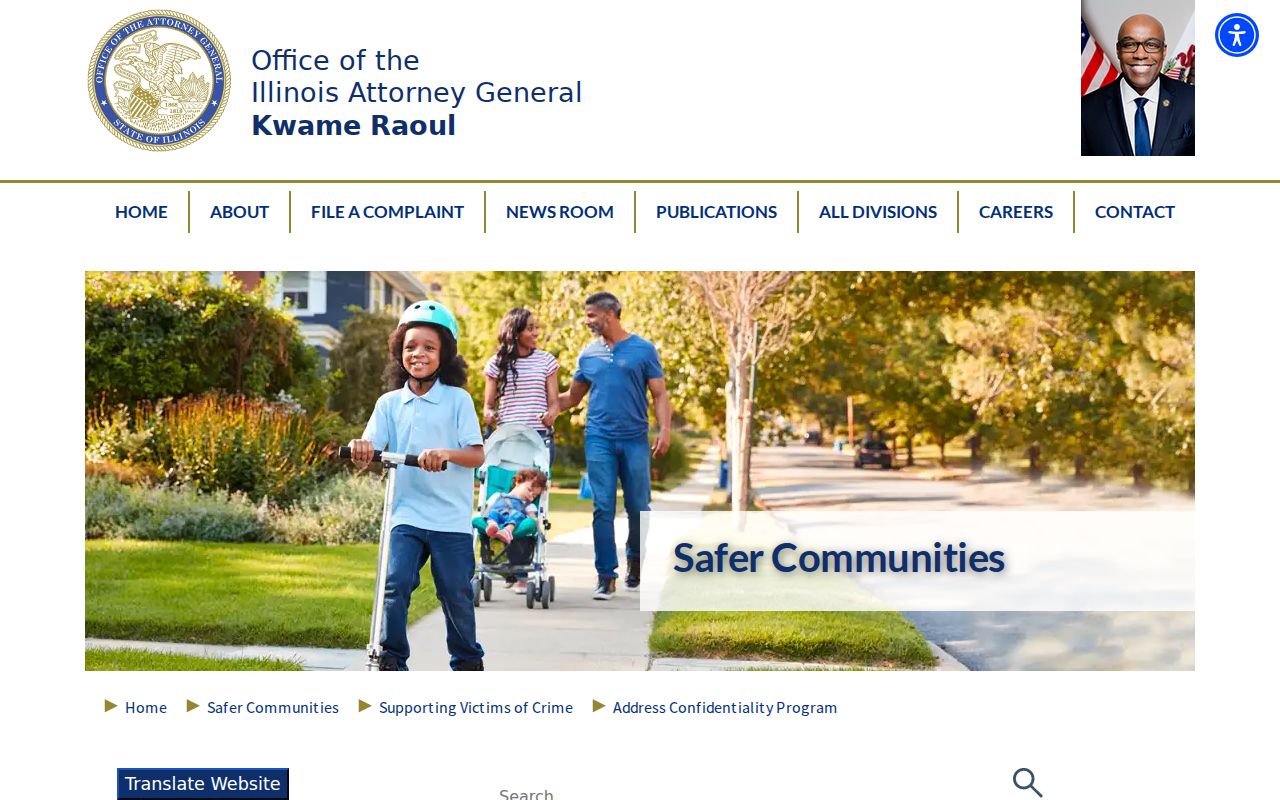
The state page explains who may apply, how the substitute address works, and why other safety steps may still be needed.
Historical Champaign County Directories
The Urbana Free Library's Champaign County Historical Archives reports directory coverage from 1870 to the present, including city, telephone, and criss-cross formats. UIUC digitized volumes broaden the trail to Mahomet, Rantoul-area towns, St. Joseph, Tolono, Fisher, and other communities. An 1878-79 volume includes alphabetical residents, classified businesses, a street section, and a gazetteer. Later books use abbreviations for residence, boarding, directions, occupations, corners, and nearby places.
Search two or more years because a listing is a dated lead. Then compare a newspaper page, census year, deed, vital or probate record, cemetery source, or family file. Missing scans route to library staff, CCHA's research room, UIUC holdings, IRAD, or microfilm. Some items are noncirculating and need advance retrieval. The full shelf and reading method appear in the Champaign County city directory.
These resident rolls also solve address puzzles. A documented Urbana example changed from 305 to 207 W Washington after Race Street moved, while a 1913-14 local renumbering account flags older Champaign street names. Old and current numbers should remain separate search fields.
Local newspapers fill many gaps between directory years. Urbana Free Library holdings include the Daily News, Daily Illini, Urbana Daily Courier, St. Joseph Record, and other county titles in print, microfilm, or digital form for differing periods. Search a surname with a street, spouse, business, church, or township, then open the page image instead of trusting an OCR snippet. Save the newspaper title, issue date, page, and image citation. Obituaries and legal notices can link a directory name to relatives, an estate, or a move, but each item still needs a second source.
IRAD also identifies Champaign County deed records from 1833 through 1902, deed indexes through 1927, birth and death series from the late nineteenth century, and a death index through 1949. The online catalog is a finding aid, not a promise that an image can be downloaded. Record the series title, date span, county, and Illinois State University depository before asking staff about access. That detail makes a written or in-person request far more precise.