
Champaign County Address Eras
Different periods leave different evidence. The best source depends on the date, place, and whether the question concerns ownership or occupancy. The Champaign County previous residents trail often begins with a parcel today, moves into deeds and title abstracts, then reaches older households through directories, maps, newspapers, death records, and probate.
| Source | Years It Covers | Where Held | What It Shows |
|---|---|---|---|
| Recorded deed history | Current online span not stated | CCGISC and Clerk/Recorder | PIN-based transfer leads and recorded images |
| City, phone, and criss-cross directories | 1870 to present holdings | Urbana Free Library and local archives | Dated names, addresses, work, and household clues |
| Digitized directories | Online runs include 1878 to 1950; UIUC collection about 1878 to 1970 | City, library, and UIUC collections | Alphabetical and street entries across many county towns |
| Sanborn maps and historic aerials | Sanborn publications 1883 to 1930; listed aerials 1936 to 2014 | UIUC and City preservation resources | Building, lot, number, use, and physical change |
| Death, probate, and newspaper records | Series-specific | Library, County Clerk, Circuit Clerk, IDPH, IRAD | Dates, relationships, estate leads, and address context |
Use the newest reliable record first and move backward. For a recent parcel, preserve the PIN and legal description. For a nineteenth- or twentieth-century household, search the directory year on each side of the target date and inspect the actual page image. For a death or family link, follow the source-specific eligibility and archive route.
Old Champaign County Addresses
Address history comes before name matching. A present-day number may not exist in the volume being searched, and one site can carry a USPS place name, legal municipality, township label, and old city name. The local record for 207 W Washington Street in Urbana makes the point clearly. Its historic survey identifies the earlier number as 305 W Washington and links the change to Race Street moving half a block west around 1918.
The same survey ties the address to PIN 93-21-17-327-007, directories, Sanborn sheets, and a dated owner and occupant chronology. It identifies Dan L. Christopher as the first owner for 1914 through 1923 and Robert D. Carmichael for 1924 through 1947, subject to verification against the deeds and directory pages. Search both numbers and keep ownership distinct from residence.
Trace Champaign County Deeds Backward
The deed path begins with the current PIN, not a guess about a surname. Use the Treasurer or Assessment records to confirm the parcel, then query CCGISC Recorded Deed History. The public search can order results and takes a PIN, but the county warns that its deed-only display may list just one grantor and one grantee. Follow the recorded image or office record before treating a transfer lead as complete.
- Confirm the present address, PIN, parcel geometry, and legal description in county property sources.
- Find the current transfer lead in CCGISC Recorded Deed History and record its date, instrument type, and document reference.
- Inspect the full recorded image through Tapestry when authorized to pay, or request it from the Clerk and Recorder.
- Use the seller as the earlier grantee and repeat, checking probate, plats, and title abstracts when the chain changes form.
- Move to deed books, IRAD holdings, library files, or written office help when the online trail ends.
- Grantor
- The party transferring an interest in recorded property.
- Grantee
- The party receiving that interest.
- Chain of title
- The linked sequence of transfers for the same property.
- Legal description
- The lot, block, subdivision, metes-and-bounds, or other land wording that can remain useful after a street number changes.
Tapestry is a linked paid or account service. Its exact live fields, price, and Champaign County image cutoff were not available in the research. The office counter and written request route are essential access channels, not afterthoughts.
Pair Champaign Directory Years
Previous residents who did not own the parcel often appear first in a city, telephone, or criss-cross directory. Urbana Free Library reports Champaign County directory holdings from 1870 to the present. Online city directories cover listed runs from 1878 through 1950, and UIUC's digitized Johnson volumes extend roughly from 1878 to 1970 while including many regional towns beyond Champaign and Urbana.
- Search the target year by surname, initials, spouse, household member, and both the old and current address.
- Inspect the alphabetical, street, and classified sections, then expand abbreviations such as res, bds, bet, cor, and compass directions.
- Compare the prior and next available directory. A missing volume cannot prove that the household was absent.
- Pair the dated entry with a public census schedule when the year and release rules allow, then check the household and nearby addresses.
- Confirm the identity with a newspaper, death, marriage, probate, cemetery, deed, or title-abstract record.
The Champaign County city directory page covers the collections and how their entries read. For house history, the key is the change between years: when a name appears, disappears, moves, or changes its address form.
Champaign House Files and Maps
Title abstracts can carry far more than a simple owner list. Urbana Free Library's guide describes deeds, mortgages, releases, tax sales, easements, surveys, plats, annexations, restrictions, lawsuits, liens, wills, special taxes, utility assessments, and mineral rights. About 5,600 files are cataloged. The stated address format begins with street name and town, followed by direction and house number; advanced fields help with a town or township outside Champaign-Urbana.
Sanborn maps add the physical setting. UIUC's collection covers publication years from 1883 through 1930, while Champaign's historic resources identify downtown map years including 1887, 1892, 1897, 1902, 1909, and 1915. A sheet can confirm lot, block, house number, footprint, construction, and use. It does not name all previous residents. Historic aerials and permit records can then show when the structure changed.
Death Records for Previous Residents
The Urbana Free Library death-record holdings provide a local historical route when a past occupant's trail ends. The research identifies an indexed county death run for 1878 through 1949, local death certificates for 1902 through 1915, and a different local or state route for later years. An index hit is a lead, not the certificate itself.
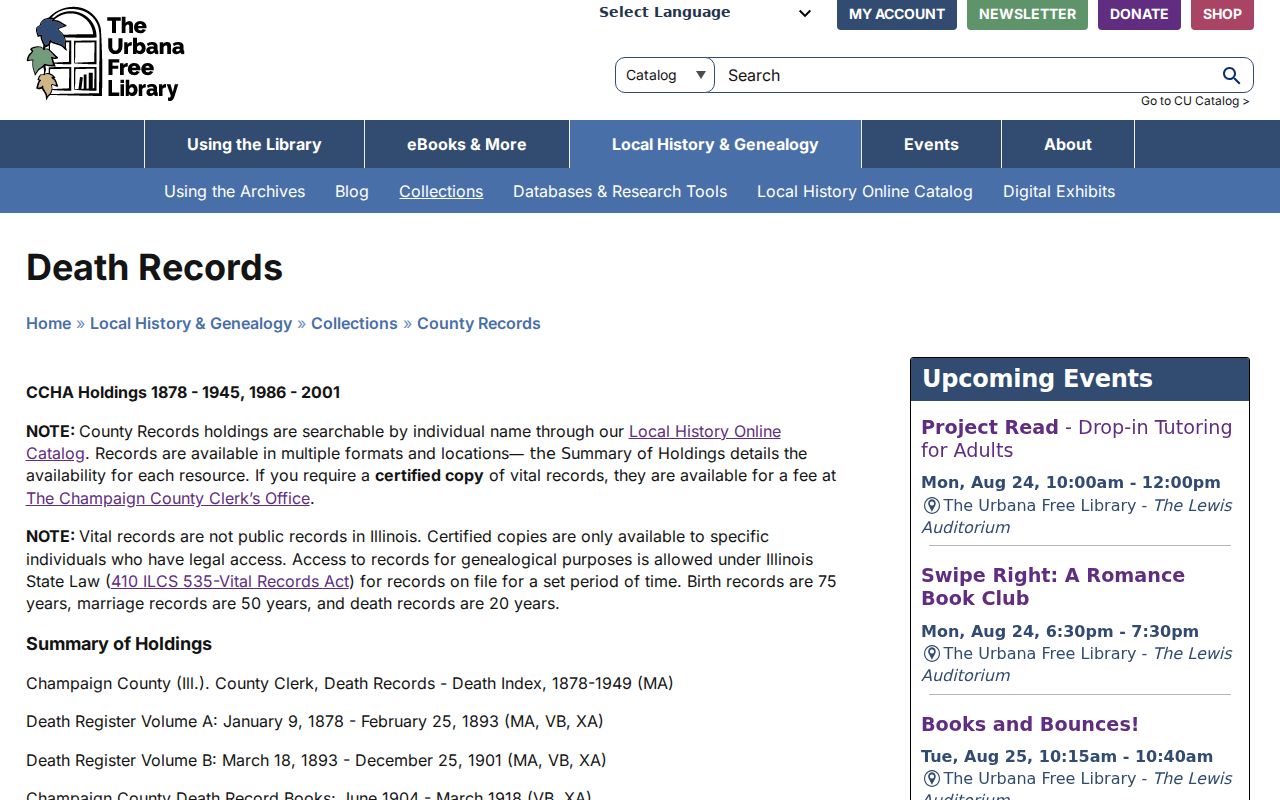
The image shows the library's county-record collection context. Record the precise series and year span so a gap in one index is not mistaken for proof that no death occurred.
The Illinois Department of Public Health death-record route explains eligibility for certified records and the distinct genealogy product.
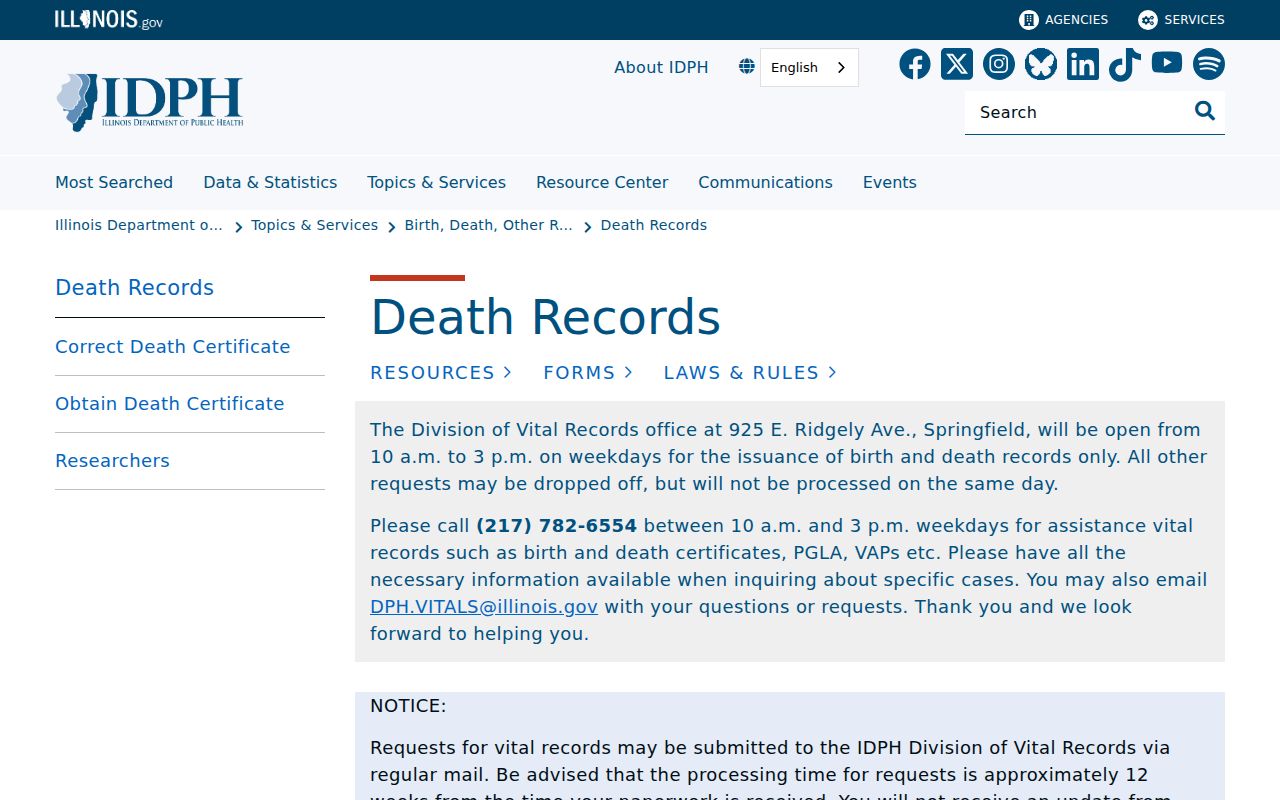
This state page is the current authority for access and request rules. A nonrelative seeking a certified copy may need proof of a personal or property-right interest, so confirm eligibility before sending ID or payment.
Illinois Genealogy for Past Residents
The IDPH genealogy guidance separates genealogical access from a current certified-copy request. It describes birth access after the stated 75-year threshold and genealogical death copies after more than 20 years, subject to state rules. Pre-1916 material may route to the county clerk or IRAD.
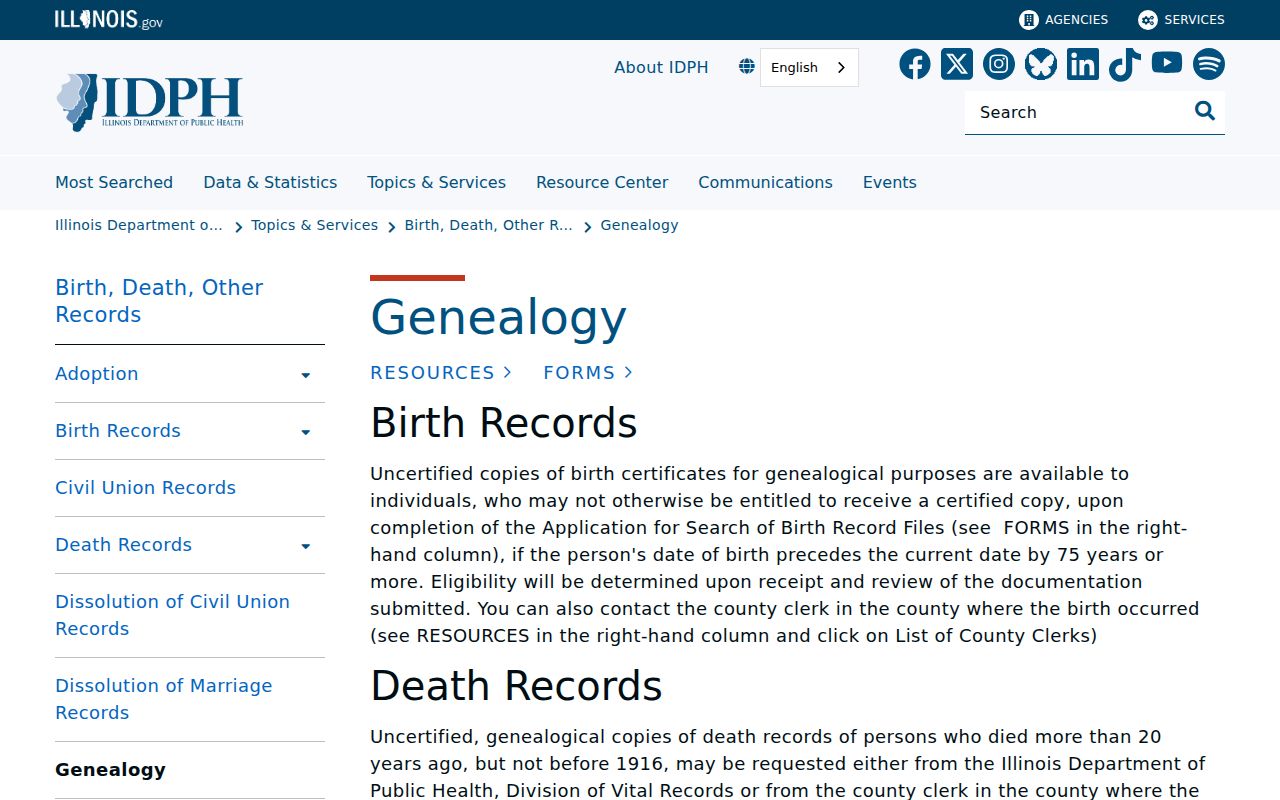
The screenshot anchors that distinction. Illinois archival law also provides conditional inspection routes for older original birth, death, and marriage records at the State Archives, IRAD, and approved libraries. Those archival thresholds do not turn a historical reproduction into a modern certified certificate.
Champaign Obituaries and Probate
Newspapers can connect an address to a spouse, relative, event, business, church, or estate notice. Urbana Free Library lists county newspaper holdings from 1852 to the present, mostly on microfilm, with digitized runs for titles such as the Daily News, Daily Illini, Urbana Daily Courier, and St Joseph Record. Search OCR, but always inspect the page image and preserve the title, date, page, and wording.
Probate can extend the backward trail through an executor, heirs, a will, inventory, sale petition, or transfer. Champaign County Circuit Clerk's request form includes Probate and Guardianship, and older court holdings reach into the late 1800s. FamilySearch lists Champaign probate coverage for 1851 through 1921. Use the online court lead, viewing room, written request, library, FamilySearch, and IRAD as separate channels. Minimize financial details, signatures, minor information, and living addresses.
Champaign County Archive Fallbacks
Not every useful record is online. CCHA's Research Room holds directories, yearbooks, maps, photographs, ephemera, and people or family files. Its posted schedule is Wednesday 1 to 5, Thursday 1 to 7, Friday 1 to 5, and Saturday 10 to 5, with reservations encouraged. Urbana Free Library's local-history material is non-circulating, and some staff retrieval can take 48 hours.
UIUC, IRAD at Illinois State University, FamilySearch catalogs, and local historical collections provide more routes. A no-result log should name the exact system, address form, date range, spelling, retrieval date, and source limits. Try neighboring directory years and another custodian. Do not turn a missing scan, destroyed register, or unindexed file into proof that no previous residents existed.
Confirm Champaign County Past Households
Owners are only part of the story. To confirm previous residents, align each dated directory entry with the address as it appeared then, a map or parcel source, and one independent family or event record. Note whether the name came from an alphabetical listing, street index, OCR text, obituary, death index, census schedule, or probate file. Each has a different level of proof.
Cemetery and funeral sources can supply dates, relationships, and spelling variants when civil indexes are thin. Urbana Free Library, FamilySearch, and UIUC's Baselt-Moeller Cemetery Research Collection preserve local material. A historical account says an 1892 caretaker-cottage fire destroyed original Mount Hope records, which makes parallel sources especially important. Treat the account as a lead and look for cemetery books, DAR compilations, funeral records, news notices, probate, and death indexes.
Lawful use. Research Champaign County previous residents for family, estate, civic, or house history. Never use the trail to track, expose, intimidate, or harass a living person.
Keep current home addresses, birth dates, phone numbers, email, minor identities, victim information, and sealed records out of any published notes. For a living relative, a library, archive, public organization contact, or neutral intermediary may forward a message without disclosing a private location.