
Champaign County Lookup Sources
Each official source answers a narrow question. Court records show a party’s role in a filed case. Vital records can confirm a family event when the requester meets the access rule. A license or business filing shows a public professional role, not a private residence. Historical sources are often best for genealogy or reconnecting because they answer the question without revealing a living person’s current address.
| Record | What It Can Confirm | Where | Access |
|---|---|---|---|
| Court case | Party name, case type, filing, docket, disposition | Circuit Clerk | Online, viewing room, or request |
| Voter registration | A response using supplied identity fields | Illinois voter lookup | Restricted public lookup |
| Vital record | Birth, death, marriage, or dissolution facts | IDPH and local custodians | Eligibility, ID, and fees vary |
| Probate or unclaimed property | Estate roles or a possible state-held claim | Illinois I-Cash | Free search; proof required to claim |
| Public license | Credential type, status, dates, discipline source | IDFPR | Free, updated daily |
Choose by purpose, not by how much data a portal displays. Family research may start with the Urbana Free Library death index and newspapers. A court question belongs with the Circuit Clerk. A regulated credential belongs with IDFPR. Record the retrieval date because current systems change.
Confirming Champaign County Court Names
The Circuit Clerk’s public case information is the main county name-search route. Its official FAQ states that civil cases created on or after January 1, 2010 can be viewed online or on courthouse viewing-room computers. Older files, certified copies, and searches not resolved by the portal need the clerk’s request route. Adoption, juvenile, sealed, expunged, sexual-assault, eavesdropping, and impounded material may be unavailable.
| Result detail | How to record it |
|---|---|
| Case number and type | Keep the exact number, court, and category. |
| Party role | Distinguish plaintiff, defendant, decedent, or other role. |
| Docket | A dated list of filings and court events, not the documents. |
| Disposition | Use the stated outcome; never infer it from a charge or filing. |
| Access status | Note whether a document is public, restricted, or unavailable. |
The record search and copy form asks for first, middle, and last names, birth date, years, and a record type. It covers criminal, traffic, civil, city ordinance, probate, and guardianship. The form states $6 per year searched and $6 per certified record, plus page-copy charges. It can be mailed, faxed, or delivered to 101 E Main Street in Urbana. Call 217-384-3725 before sending a broad request.
Note: A case filing proves only that a matter entered the court system; confirm the party, dated events, and final disposition separately.
Verifying a Champaign County Resident
Same-name errors are the chief risk in a resident lookup. A nickname, married name, middle initial, township label, or old city name can split one person across several indexes. Conversely, one common name may belong to several county residents. Use only the details needed to distinguish the record, and require two independent points of agreement.
- Write the known name variants and an approximate time or place. Do not begin with a full birth date unless an official form requires it.
- Search the least sensitive useful source, such as a directory, newspaper, cemetery index, archive catalog, or public license.
- Compare a second official or archival source for a matching date, town, family tie, business role, or prior address.
- Label each hit as a lead until the underlying record or second source confirms it. Record failed searches and access limits too.
- For contact, ask a library, historical society, public group, or mutual contact to forward a message rather than disclose a home address.
- Docket
- The court’s dated list of filings, hearings, orders, and other case events.
- Index versus image
- An index points to a record; an image shows the recorded page or filing itself.
- Certified copy
- A custodian-authenticated copy used when ordinary printouts are not enough.
The full address-based chain belongs in the Champaign County street directory. For one person, a compact identity table with source, date, exact name, matching fact, and conflict is safer and easier to audit.
Champaign County Voter Lookup Limits
The Illinois registration lookup asks for first name, last name, birth date, and ZIP, with street controls appearing conditionally. It confirms a registration response from facts the searcher already supplies. It is not an open statewide directory and should not be scraped or used to assemble a list of homes.
Illinois Election Code rules restrict voter data and prohibit forms of commercial solicitation, intimidation, threats, deception, advertising, and marketing. A negative result may reflect an input mismatch, a protected route, a move, or portal validation. It is not proof that a person never lived in Champaign County. For genealogy, a city directory or archival voter material may be more apt than a current registration check.
Champaign County Family Connections
Family and heir research can often stay in historical sources. The Urbana Free Library and Champaign County Historical Archives hold directories, newspapers, cemetery material, family files, and county records. The library’s county death index spans 1878–1949, while its local death holdings include registers, record books, certificates, and coroner certificates with distinct date ranges. An index hit is a lead, not a certified death record.
For probate, the Circuit Clerk request form includes probate and guardianship. FamilySearch lists Champaign probate coverage for 1851–1921, and IRAD finding aids can route older county series. A sound probate note records the decedent, case number, filing date, executor, heirs as shown, document title, and access status. It omits account numbers, minor details, and private addresses.
Illinois I-Cash is free and updated weekly. Its search uses last or business name, first name, and optional city, ZIP, or property ID. A match is only a possible claim. The Treasurer decides proof and entitlement for an owner, heir, or representative. Adoption questions require IDPH’s IARMIE, adult-adoptee rules, or the Confidential Intermediary process, not informal reconstruction of a sealed identity.
Champaign County Status Records
The Sheriff’s inmate page links the current jail search and dated arrest, arraignment, and jail reports. The county says the jail route needs first and last name when known, and results may show charges and bond. A booking is not a conviction. Confirm the related case and disposition with the Circuit Clerk.
The official county jail lookup page introduces that route:
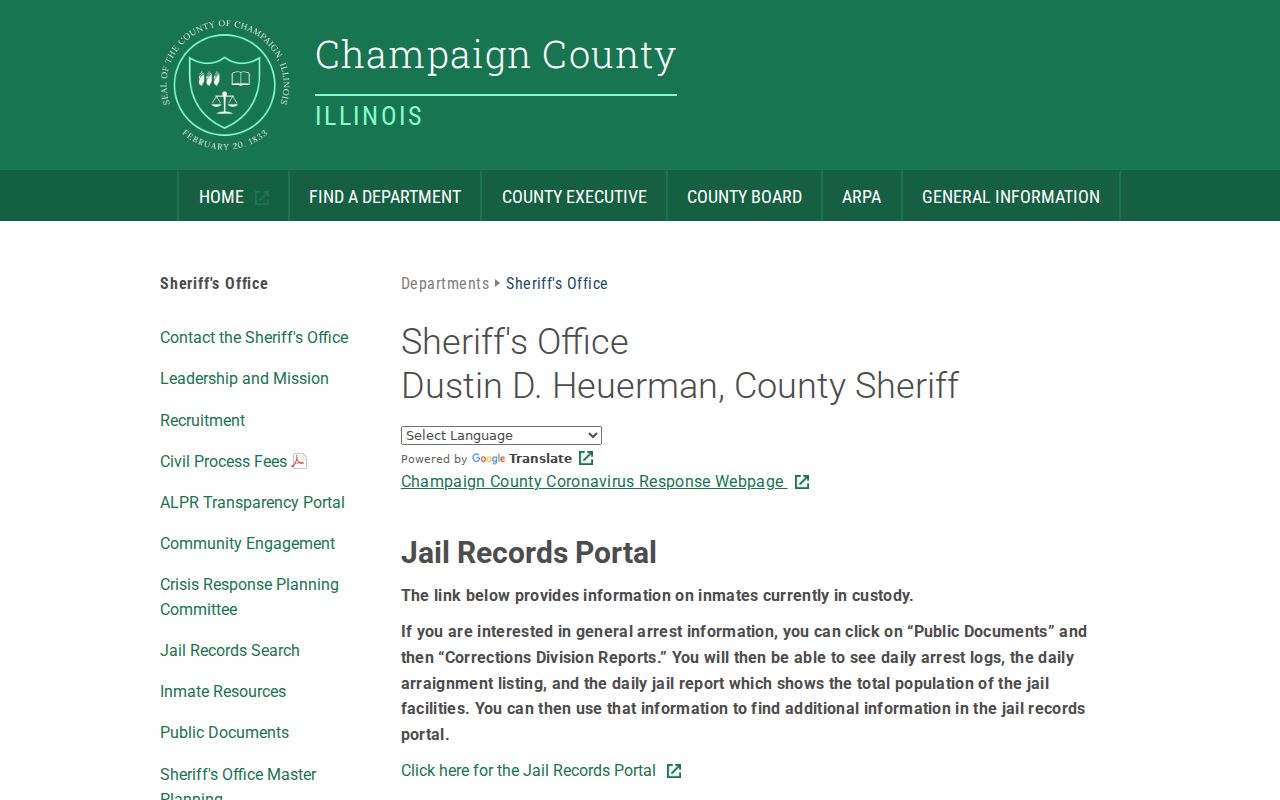
The captured page identifies the custodian and public reports, while the external jail portal’s field list and full date coverage remain unverified.
The Illinois offender registry is a separate public-safety system with name, birth date, city, ZIP, county, status, and radius controls:
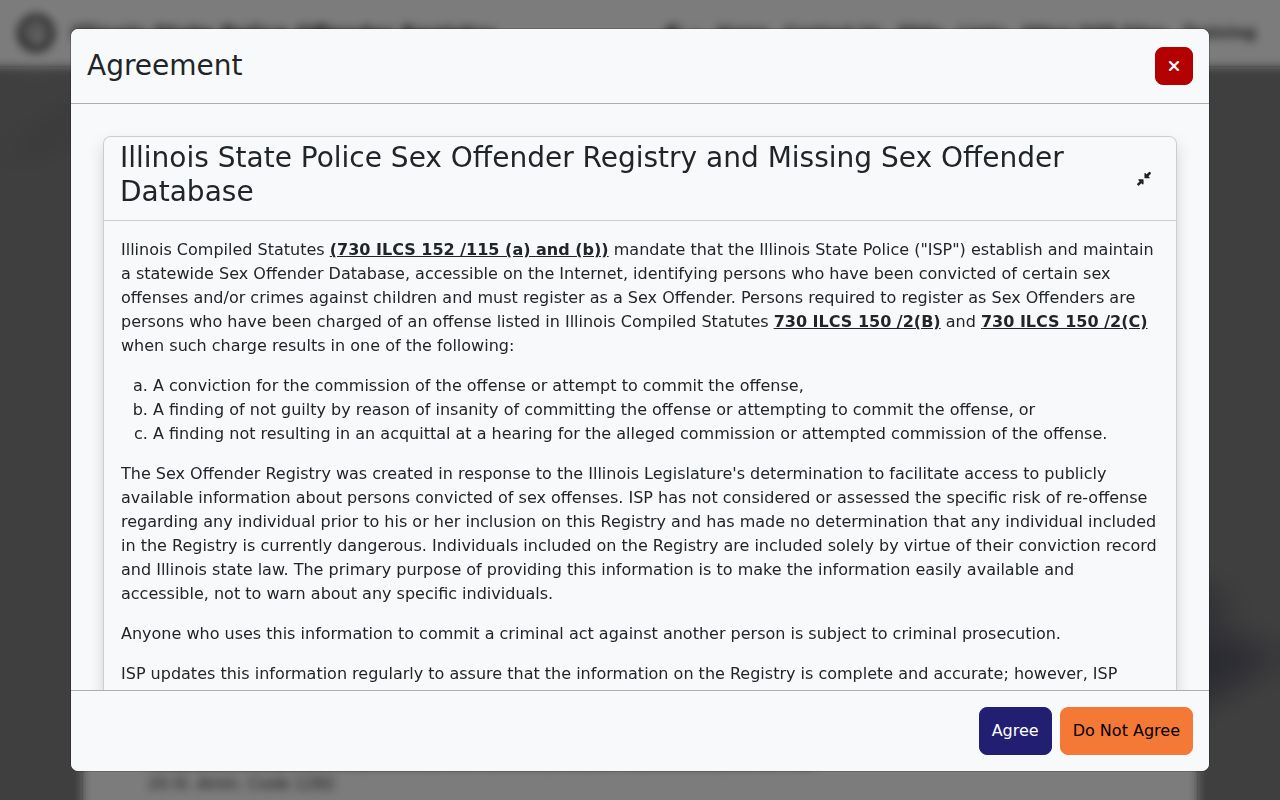
Its disclaimer and statutory limits govern every use. Do not combine registry, jail, voter, and parcel data into a profile or targeting list. VINE at 866-566-8439 offers custody-status notifications for safety needs and is not a person-discovery service.
Reading Champaign County Search Gaps
A blank resident lookup result needs a reason code. The Circuit Clerk’s online civil date boundary may exclude an older file. A library volume may be missing, non-circulating, or awaiting staff retrieval. A vital record may be restricted by age, identity, or eligibility. An interactive portal may also fail to expose its full controls.
Keep the exact input, spelling variants, custodian, URL, search date, stated coverage, and outcome. Mark the result as a system gap, index gap, retention gap, access restriction, or possible true negative. Then use a documented fallback: courthouse viewing room, narrow mail or fax request, custodian phone call, archive request, microfilm, or IRAD finding aid. Never fill a gap with an unverified commercial profile.
Lawful Champaign County Resident Lookup
Public access does not make every field safe to collect or publish. Illinois FOIA permits redaction of private information and unwarranted invasions of personal privacy. Vital, voter, adoption, juvenile, sealed, and victim-related records have their own limits. A denial is the correct research result when the law closes the record.
Lawful use. Use a Champaign County resident lookup for legitimate genealogy, reconnecting, estate, civic, consumer-safety, or personal-safety work. Never monitor, threaten, harass, impersonate, or expose a person.
The Illinois Attorney General’s Address Confidentiality Program provides eligible survivors a substitute address for four years with renewal. It cannot assure confidentiality of property records. Respect protected addresses, minimize the information saved, and use the program contact or an official safety channel when risk is involved.